Tiny Ruins Tycoon
A downloadable game
A cozy idle/management game set in a forgotten world — designed around long-term incremental progression, multi-resource economy, and a narrative that unfolds through the act of building. Currently in design and prototyping phase; no public build available yet.
This page documents the design thinking behind the systems. The project is being developed solo in Unity with Firebase for persistence.
Role: Lead Game Designer (solo)
Stack: Unity · Firebase / Firestore · Unity Ads · Unity IAP
Platform: Mobile (Android) — PC port planned
Core Concept
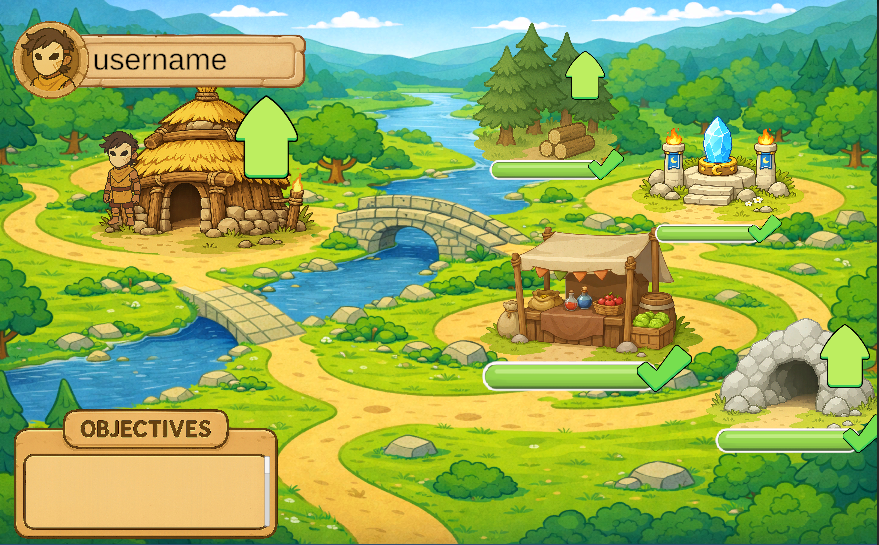
The player awakens in Lumenvale — a world devastated by an ancient magical fog. As the Guardian, their goal is to restore ruined structures, awaken spirit workers called Tinykins, and rebuild the village across four distinct eras: Ruin, Prosperity, Arcana, and Celestial.
The design goal was to make progression feel meaningful at every scale — not just numbers going up, but the world visually and narratively transforming as a direct result of the player's decisions.
Design Decisions
1. Progression curves: keeping growth legible without feeling flat
The economy uses two separate scaling formulas. Building production scales at base × 1.25^level, while upgrade costs scale at base × 1.15^level. The gap between these two curves was deliberate: production outpaces costs early, creating a strong sense of momentum, while the gap narrows in the mid-game to introduce friction and push players toward era transitions rather than infinite local optimization.
Each era transition resets the base values and multiplicators, which serves two purposes: it keeps numbers readable throughout the game, and it gives the player a clean psychological reset — the sensation of starting over, but stronger.
2. Multi-resource economy with distinct roles
The game uses five resources — Wood, Stone, Gold, Essence, and Gems — each with a specific role in the economy. Wood and Stone are the primary production resources, consumed by building and upgrading structures. Gold is the conversion layer, produced by the Merchant's Tent from raw materials. Essence is the late-game resource tied to magical progression and era transitions. Gems are the premium currency, used to restore Energy or accelerate production.
The design intent was to avoid the common idle trap where all resources collapse into a single "number goes up" loop. Each resource creates a different decision context: Wood and Stone require capacity planning, Gold requires conversion timing, Essence requires strategic restraint.
3. Energy as a pacing tool tied to narrative
Manual actions — collecting resources, constructing buildings, upgrading structures — all consume Energy. Energy regenerates naturally at 1 unit per 10 minutes base, and the Guardian's House reduces regeneration time as it levels up. This creates a soft session cap that controls how much a player can do in a single sitting without paying or watching ads.
The design choice to frame Energy as the Guardian's vitality — not just a mechanical limiter — was intentional. When the world is thriving, the Guardian is energized. When the player returns after time away, the Energy has restored itself, reinforcing the idle fantasy of a world that continues without you.
4. Random events to break monotony and create decision moments
Pure idle games risk becoming purely passive after the initial setup phase. The event system was designed to interrupt the routine at irregular intervals with outcomes that require a choice: a traveling merchant offering a rare resource trade, a magical storm that boosts production but damages a building, a lost Tinykin that needs to be guided home in exchange for a bonus.
Each event has a positive, neutral, or negative resolution depending on the player's decision and current resource state. The intent was to create moments of engagement without demanding constant attention — the game respects idle time but rewards players who check in.
5. The Tinykin Sacrifice — era transition as narrative design
The transition between the Arcana and Celestial eras required a design solution for a difficult problem: how do you make a prestige reset feel meaningful rather than mechanical? The answer was narrative. At the peak of the Arcana era, the Tinykins — the spirit workers who built the world alongside the player — reach full consciousness and choose to sacrifice themselves to allow humans to return.
The player witnesses their transformation and accepts the sacrifice. From this act, a Hybrid Tinykin is born — a unique companion who carries the memories of all the others and accompanies the Guardian into the final era. The prestige reset happens, but it's framed as completion, not loss. The world isn't wiped — it's reborn.
What I'd Change With More Time
- The mid-game pacing is the biggest unsolved problem. The early loop (build, collect, automate) is well-paced, but the transition into the Arcana era risks feeling like a cliff — not enough new decision types to justify the longer grind before the era shift.
- The event system needs more variety and contextual awareness — events should react to the player's current era, resource state, and Guardian level rather than firing from a generic pool.
- Tinykin differentiation could go further. Currently they're primarily visual. Giving each Tinykin type a slightly different production behavior would add a light optimization layer without breaking the cozy tone.
What This Project Demonstrates
- Incremental economy design: production curves, cost scaling, and multi-resource balance
- Pacing design: Energy systems, session control, and long-term progression arcs
- Era-based progression: resetting base values while preserving player momentum
- Narrative integration: using story beats to frame mechanical transitions (prestige as sacrifice)
- Idle loop design: balancing passive growth with active engagement moments
- GDD documentation: full design document covering systems, economy, narrative, and monetization
Leave a comment
Log in with itch.io to leave a comment.